

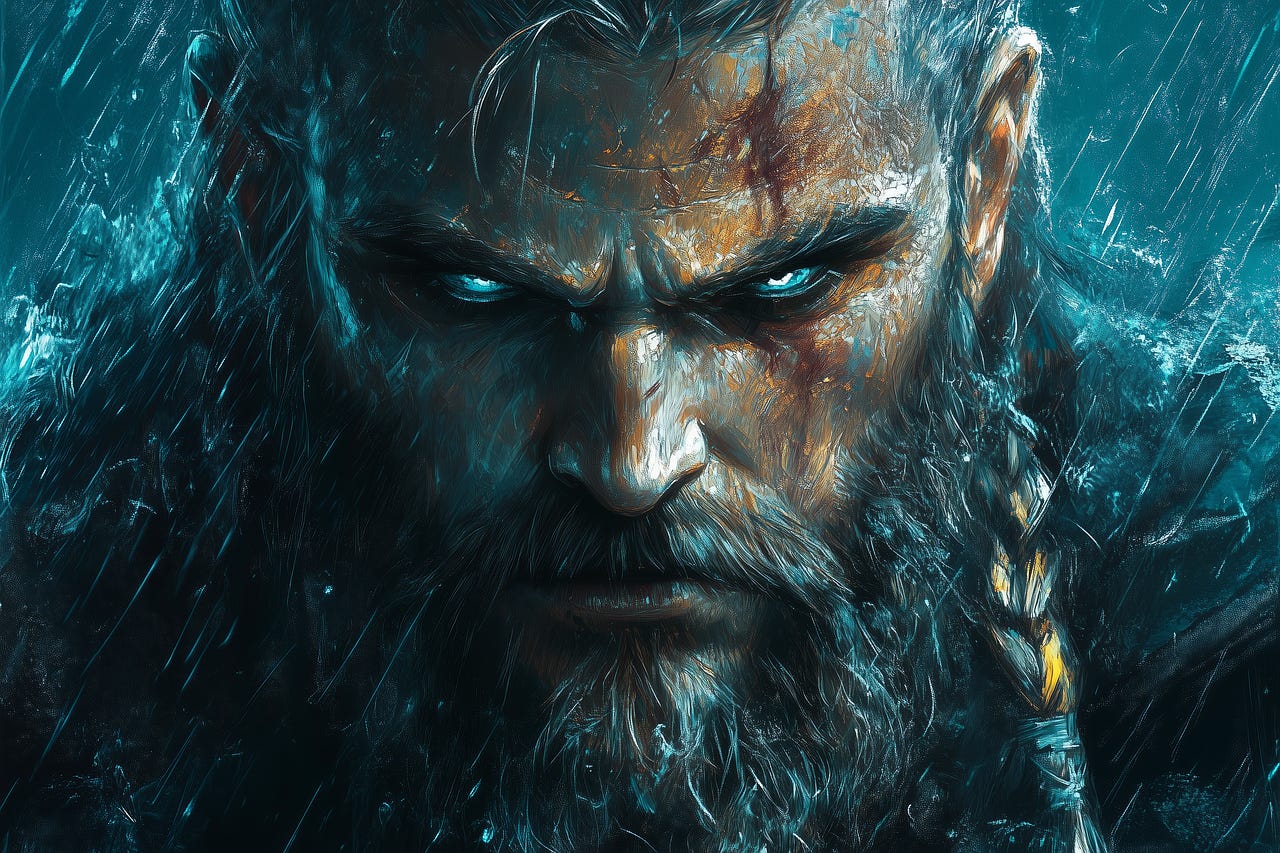
What does it mean to be unbreakable? In this episode, we explore the heroic mindset found in myth, philosophy, and warrior tradition. Drawing from a particular story from the Viking Age, we’ll uncover how ancient lessons can guide us in building resilience, honor, and strength in a modern world that seeks to weaken men. This is about more than survival, it’s about becoming unbreakable.
The world is full of forces trying to break you. It draws from a vast array of weapons, chiefly among them are fear, resentment, and emptiness. It’s the same three enemies that that have plague the soul of man since the beginning of time, now playing out in our modern cycle. And just like our ancestors sharpened their swords and spears to battle against physical foes, those who pursued an enlightened path trained their minds and spirits to battle against the enemy within.
We know this because the myths and legends they passed down to us were seeded with signs and clues to lead us a long the way. They left us templates for action to become unbreakable.
And that’s what his episode is about. It’s a primer on forging your spirit through discipline, story, and the fire of the heroic life.
This transmission is sort of a second installment of the episode I did with John Michael Greer about operationalizing myths in the life of a warrior. In that episode we discussed what myths are, why they were so important to the warrior cultures of old, and how they used them to forge a spirit of strength and resilience.
The world will try to break you. Your job is to see that it fails. Our ancestors will show us how.
Let’s go..
At some point in our lives, we all have to stand face-to-face with the same three enemies.
Fear.
Resentment.
Emptiness.
We’ve all felt the sting of fear at some point in our lives. It hits like venom paralyzing you and freezing you in place. It destroys your confidence and whispers things like, I’m not ready or what if I fail, and so on. Think about it. How many opportunities have you let slip because fear talked you out of pursuing them?
Then there’s resentment. Our world is awash in bitterness and resentment. Resentment ties you to the past, to every slight and envy, until all you’re carrying is bitterness. How many relationships have you lost or blessings you’ve failed to recognize all because resentment had you by the throat?
And then there’s emptiness. It’s the void pressing on your chest. It hollows out your drive, your sense of purpose, even your hope. It turns joy into dust and makes action feel meaningless. How many passions, adventures, connections have slipped away because emptiness convinced you none of it mattered?
Fear. Resentment. Emptiness. They rob you one moment at a time. The question is, are you going to let them?
If you’ve ever found yourself stuck that mind loop of self-defeating narrative, I have good news because our ancestors didn’t leave us defenseless. They left us myth. They left us stories and legends from the lore to serve as a template for action and victory.
And I’m going to share with you one of the most sacred stories from the past. It’s one where find three forces, three gods, three gifts that overcome those enemies.
This episode is about that story.
It’s about the brothers who gave us spirit, mind, and fire. It’s about how to awaken those gifts in yourself before fear consumes you, resentment defines you, and the void swallows you whole.
This episode is a story about you.
Let’s go back to the beginning.
Driftwood on the Shore

In this episode, I want to give you an example of how you can unleash the power of these ancient myths in your own life. We live in a post-modern materialist age that has sucked our souls dry of the richness and vitality that the spirit of our ancestors once commanded.
Rediscovering and accessing the power of these stories is the key to rekindle the ancient flame to burn within you today. If you would dare to see the world through their eyes, take up their challenges as your own, and live with the same courage, honor, and relentless will that shaped their legends, then you will create an epic life-story of your own.
For this episode, I’ve chosen a story from the Poetic Edda. Also known as the Elder Edda, it’s a collection of Old Norse poems preserved mainly in the 13th-century Codex Regius, though its contents are far older, rooted in the oral traditions of pre-Christian Scandinavia. Among its most famous poems is the Völuspá (“Prophecy of the Seeress”), in which a völva, a wise woman and prophetess, recounts the creation of the world, the deeds of gods and men, and the doom that awaits them at Ragnarök. Rich in myth, symbolism, and cosmic vision, the Völuspá serves as both a creation myth and an apocalyptic prophecy, framing the Norse worldview in a cycle of birth, destruction, and renewal.
So let us begin…
Before there were humans, there was driftwood.
Not people. Not proto-humans. Just two pieces of wood, washed up on the shore of a lifeless world. Their names were Askr and Embla, or Ash and Elm.
That’s all we were.
Raw material.
Potential.
And then three gods found them.
In the Völuspá, the seeress tells the tale to Odin:
"Until three came from that company,
powerful and loving Æsir,
they found on the land,
little strength they had,
Ash and Elm, fate-less.
They had no breath, no mind, no warmth,
until the gods did this…”
In this version of the story, we learn that Odin, and his two brothers, Hoenir and Lóðurr, though in other tellings, it’s Vili, and Vé—stood over the lifeless forms of what would become man and woman: Askr and Embla.
Each god gave a gift.
Each god leaned in and bestowed a gift.
Odin: he breathed into them önd. This is spirit, the living spark that animates the flesh and stirs the soul.
Hœnir granted vit—mind, consciousness, reason, and the seed of choice itself, the foundation of human will.
Lóðurr bestowed lá—form, vitality, and the fire of life; the pulse of passion, desire, and drive that moves a being to act in the world.
In another telling, the first humans were shaped by Odin and his brothers Vili and Vé. Together, they found the lifeless logs that would become Askr and Embla and gave them the gifts that would define humanity.
Odin breathed life into them, gifting spirit—the animating force that separates the living from the inanimate.
Vili granted intelligence and will, the ability to think, reason, and make choices that shape their own path.
Vé bestowed appearance, vitality, and warmth, the physical form and beauty that make life tangible and capable of expression.
In this version, the pattern is strikingly familiar: spirit, mind/will, and body/vitality—the same pillars as in the Hœnir-Lóðurr account, just under different names and slightly different emphases.
Though the gods’ names differ between the two accounts, the gifts they offer are remarkably consistent:
Spirit (önd)—Odin gives the spark of life that animates every human being.
Mind and will (vit or intelligence)—Hœnir or Vili gives the ability to think, reason, and exercise choice. This is the seed of human will, the power to shape one’s own destiny.
Form, vitality, and passion (lá/litr or Vé’s gift)—Lóðurr or Vé gives the body, the energy, the drive, and the fire of life, enabling action and passionate engagement with the world.
Regardless of the version you read, the story points to the same truth: humans are a fusion of spirit, mind, and living energy, designed to act, to choose, and to live fully.
Together, these gifts forged the first humans: a union of spirit, mind, and body; a being capable of thought, choice, and passionate action. Askr and Embla rose, fully alive, standing at the dawn of the world, their hearts and minds set on shaping their own destiny.
From that moment, Askr and Embla stood. Alive. Awakened. Human.
Let’s pause here, because this is more than a creation myth. This is a code.
In this myth, the gods didn’t just breathe life into the first humans, they imprinted a map onto our souls.
But first, let’s talk about Odin
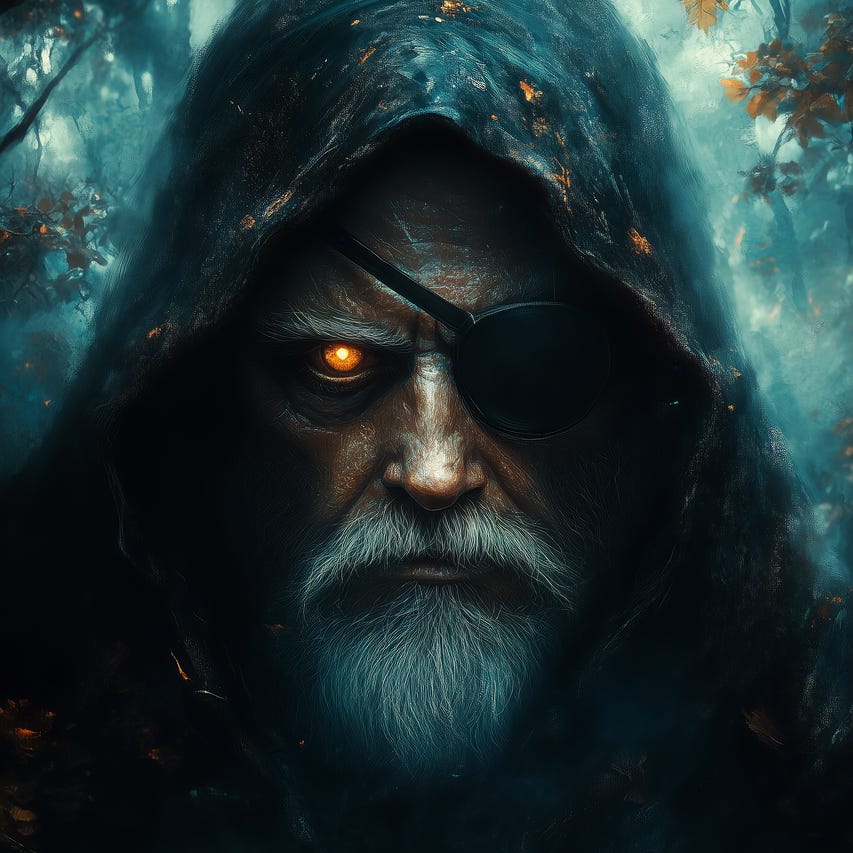
Of course, the story loses some of its punch if you don’t understand the background of the characters involved - especially Odin. For our ancestors, an understanding of Odin, who is was and how he figured in the myths would have been understood at the cellular level. For most of us moderns who are steeped in the lore, a little background is in order. Trust me, once you understand the nature of Odin and the way he figures in the story, the tale of Askr and Embla become much more powerful, so let’s flesh it out.
In Norse mythology, Odin isn’t simply the “chief god” of the pantheon. He embodies something much older, much wilder. His very name is tied to the Old Norse word óðr, which is one of the very gifts he bestows to Askr and Embla. His name carries with it meanings like “fury,” “inspiration,” and “spirit.” That’s important, because Odin himself is the restless spirit of becoming. He’s never static, but always seeking to increase in wisdom, power, and mastery.
You’ve may have heard the tale of how he sacrificed an eye. That wasn’t just a symbolic gesture; it was an actual mythic act at Mímir’s well, the well of wisdom. Odin gave up half his sight to gain deeper vision. He sought the kind of perception that pierces beneath the surface of the world. By placing his eye into the well in exchange from drinking from its waters, he traded the ordinary for the extraordinary, the comfortable for the costly. And that’s the core of his character that you see in other myths about him. In order to become unbreakable, he sacrifices himself again and again.
And when the Völuspá speaks of the Aesir. This is the catch term that refers to the gods who Odin leads. They represent forces of order, strength, and sovereignty in the cosmos. They are the ones who struggle to hold chaos at bay, who built the world out of the bones of a giant, and who know, even as they fight, that their end will one day come.
So, as I mentioned earlier, the story of Askr and Embla is more than a creation myth. It’s a code.
The Battle Within
The three gifts—the spirit of Odin, the mind of Vili, the fire of Vé—correspond directly to the enemies we named at the start.
Let’s walk through them.
1. Fear meets Odin
Odin is spirit. Breath. The part of you that reaches for something higher. The part that seeks wisdom even when the price is your eye, your comfort, or your life. He’s the god poetry, of battle frenzy and mystic vision.
Fear cannot survive long in the presence of spirit.
Because spirit doesn't seek safety. It seeks meaning.
It knows death is coming either way. So it makes the sacrifice count.
To overcome fear, you have to breathe like Odin.
You have to move toward the unknown and not away from it.
This doesn’t mean recklessness. It means you accept your fate, and act anyway.
That’s the warrior’s first lesson: you kill fear with meaning.
2. Resentment meets Vili (or Hœnir)
Vili is often interpreted as will or intention—but in this myth, he gives vit—understanding, clarity, discernment.
In other tellings, this gift is given by Hœnir, the quiet, contemplative god who’s sometimes called “the silent one” or “the indecisive one.” In some stories, Hœnir can’t act unless Loki tells him what to do. What do we make of that?
Here’s the point:
Mind without spirit or fire is weak and rudderless.
But mind guided by spirit and powered by fire becomes razor-sharp.
Resentment thrives in confusion. In shallow thinking. In dysfunctional feed-loops.
It feeds on blaming others, virtue-signaling, and on seeing yourself as a victim.
There’s so much resentment in this world. Most of it is misplaced. To overcome resentment, you must awaken the gift of Villi, which in this instance is a disciplined mind.
By leveraging the power to assess things honestly, to think clearly, even under pressure, is to take ownership of your path.
If you kill fear with meaning, you kill resentment with clarity and responsibility.
3. Emptiness meets Vé (or Lóðurr)
This is the most mysterious of the gifts. Vé gives lá, which can mean blood, warmth, or sacred form. Lóðurr, in the alternate version, gives litr góða—good color, vitality, physical beauty.
Either way, this is the gift of embodiment. Fire. Passion. The willingness to live fully.
Nihilism is what happens when spirit and mind become divorced from action.
Emptiness is the absence of the sacred. In a sense, it’s the driftwood without a fire inside.
But Vé is the one who makes things sacred. His name is connected to vé—a sacred enclosure, a temple. He turns space into sanctuary, motion into ritual, and life into something that matters.
To overcome nihilism, you need to act with the fire of purpose.
Train with purpose. Build with purpose. Love your friends and family with purpose.
Do things that affirm life has worth.
You kill emptiness with sacred embodiment.
The Power of Three
So what do we take from all this?
The Norse weren’t just telling a campfire story. This was a blueprint for what it means to be a whole, capable human being. They saw life as requiring three core forces:
Spirit — the drive that gives you courage and purpose.
Mind — the clarity to see things as they are and make sound decisions.
Will — the power to take action even when it’s hard.
Lose any one of those, and you’re crippled. You might have willpower but no clear mind, so you burn yourself out in the wrong battles. You might have intelligence but no spirit, so you overthink and never move. You might have spirit but no will, so you dream big but do nothing.
The myth of Askr and Embla isn’t just about how the gods made humans.
It’s about how we become truly human again.
You are the driftwood.
If you’re a man, you are Askr. If you are a woman, you are Embla.
And the only way to rise from the sand is to call back the Three.
Call upon Odin when you’re afraid.
Call upon Vili—or Hœnir—when your mind is clouded.
Call upon Vé—or Lóðurr—when you’ve gone numb.
(When I say the words “call upon,” it doesn’t matter if you take it literally or figuratively. When it’s done with focus and intention, the outcome is the same.)
The Norse always understood that power moves in threes.
Even Odin needed his brothers to finish the work.
Even the king of the gods doesn’t create alone.
And neither do you.
Getting Practical
Let’s get real practical here.
Want to awaken spirit?
Start by sacrificing something you fear losing.
Not recklessly—but consciously.
Train in discomfort or on days you don’t feel like it
Speak a hard truth or have that difficult conversation you’ve been putting off
Spend time studying or pursuing a new skill
Fast
Meditate
In taking action you face death symbolically.
Want to awaken mind?
Stop numbing yourself with noise and distraction.
Sit alone in the woods
Reflect
Write down your thoughts or start a journaling practice
Seek to uncover the deeper truths within you
And what do I mean by that line? Part of it is simply being an honest broker with yourself. That can be a heavy lift at times. Why? Because most people can’t even recognize the resentment that they carry within them at times. If you find yourself bitter because someone has something that you don’t, or if there’s something missing in your life, you need to figure a plan of attack to get it. But before you do that, you have to be able to make an honest assessment of yourself and where you’re at physically, mentally, and spiritually, before you can set a new course or direction for your life.
That’s what it means to be an honest broker with yourself. It’s easier said than done.
Want to awaken fire?
Move your body
Create something beautiful with skill
Plant and tend a garden
Train with your hands
Make a vow and keep it
Stop doom-scrolling and Netflix-binging and use your time and energy to pursue something meaningful.
Your task isn’t to feel better. It’s to become whole.
Wrapping it up….
Fear. Resentment. Emptiness.
These are not signs of weakness. They’re signs that you’re ready.
The gods are watching the beach again.
That you’re still raw timber, but they’re willing to breathe into you.
The breath of spirit.
The mind of clarity.
The fire to kindle your sacred will.
The question is: will you receive it? Will you rise? Or will you stay driftwood?
The choice is yours.
What strategies are you pursuing to become unbreakable? Share them in the comments below.
RESOURCES:
The Poetic Edda, translated by Lee Hollander


